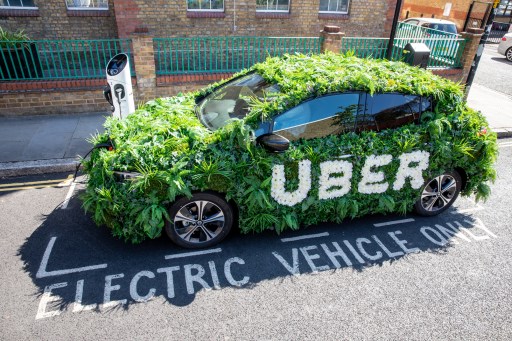
This was in the Times a day or two after City AM's article above, and it's along the same lines.
It's behind quite a tight paywall, and I'm not sure if this is the whole article, but you can get the gist by reading what's here, and it probably doesn't add a whole lot to the article above

Still worth a read, though.
Bumps in the road for plug-in taxisA new law demands that London’s cabs go hybrid or electric. Drivers fear there aren’t enough charging pointsThe pandemic sent a shock wave through London’s taxi industry from which it has not recovered. As demand for their services collapsed, there are still a fifth fewer cabbies in the city than there were in March 2020.
Now the industry faces a new struggle. In the years since Covid, thousands of private hire and black cab drivers have switched to electric vehicles (EVs). Many more will have no option but to join them imminently, thanks to a new regulation brought in by Transport for London (TfL) at the beginning of the year. It requires all new cabs to be “zero-emissions capable”, meaning they must be hybrid or electric.
This regulation is an important milestone on the way to decarbonising London’s transport system and it is already having an impact: more than 40 per cent of private hire cars and black cabs in the city are now electric. However, it is causing problems for drivers, for whom finding a charging point is not always simple.
Many taxi drivers live in flats without private parking spaces or in houses without driveways. With nowhere to place their own charger, they have to rely on public ones. These are in short supply, are often occupied and are far from drivers’ homes. Faced with this difficulty, many cabbies are reluctant to switch to EVs.
TfL has made efforts to improve London’s public charging network, which already numbers 12,800 points. It is on track to meet its goal of expanding the network to between 40,000 and 60,000 chargers by 2030. However, Mariusz Zabrocki, UK general manager of the ride-hailing app Free Now, says: “We’re still quite a long way from drivers being comfortable that they can charge their vehicles as easily as they can refuel a combustion engine car.
“When you look at a map of charging [points] in London there are some areas that are really well covered, especially in central London. Then in areas where a lot of drivers live, such as Whitechapel and Wembley . . . you will see that we don’t have sufficient charging infrastructure there, and that needs to improve.”
Whitechapel, which is in the London borough of Tower Hamlets, has about 32 public charging points per 100,000 people, roughly a quarter of the London average of 131. The shortage of public chargers in such areas will only become more problematic as more drivers make the transition to electric. TfL estimates that by 2025, 80 per cent of all public charging demand in London will come from private hire.
“They are pushing us forward with EVs but the infrastructure is not there,” says John Hamilton, the driver of a hybrid black cab. “It’s as simple as that.”
But TfL defends the pace of change, saying that “toxic air in London is a public health emergency and the transition of [taxis] is significantly reducing toxic emissions and carbon dioxide, a major contributor to global warming.”
Another difficulty that many drivers face when going electric is the 20 per cent VAT levied on public chargers. By contrast, those who are able to charge their vehicles at home pay only 5 per cent. Zabrocki notes that this creates an extra expense for those who can’t access a charging point at home. “It’s a significant part of the price that really isn’t justified by the financial situation of the users,” he says.
The cost of switching to an EV in the first place is another issue. TfL offers drivers £7,500 if they trade in a vehicle that is less than 15 years old but, even with this scheme, a new cab will cost about £60,000. Most drivers require a loan with a financing plan to buy one, which pushes up the bill by thousands.
With those expenses in mind, Hamilton says TfL should be offering more generous incentives to help cabbies go electric, citing how drivers in Scotland receive more help. “The Scottish government looks after cabbies in that way. They can literally buy a brand new taxi and get a loan [for which] they don’t have to pay any interest.” Indeed, the Switched on Taxis Loan scheme, which was launched in Scotland in May 2019, provides drivers with an interest-free loan of up to £30,000 to purchase an electric car.
The loans are available through the Energy Saving Trust and funded by the Scottish government. The scheme is closed at present, but the trust is hopeful that it will reopen in the next few weeks after funding is approved.
Rafael Cancini, a private hire driver who does not own an EV, is concerned about the possible impact of London’s new regulation on the industry. “A lot of drivers will just try to find another job and leave [taxi driving],” he says, adding: “Customers will be faced with waiting times.”

 Login
Login Register
 FAQ
FAQ