Ignoring the licensing thing, this represents another aspect of P&J elitism.
Maybe it's just me, but an absolute lack of self-awareness here - I mean, only *female* *passengers* feel unsafe in taxis, apparently

As for the licensing thing per se, possibly interesting that she's basically saying the councillors are biased based on whether they're male or female
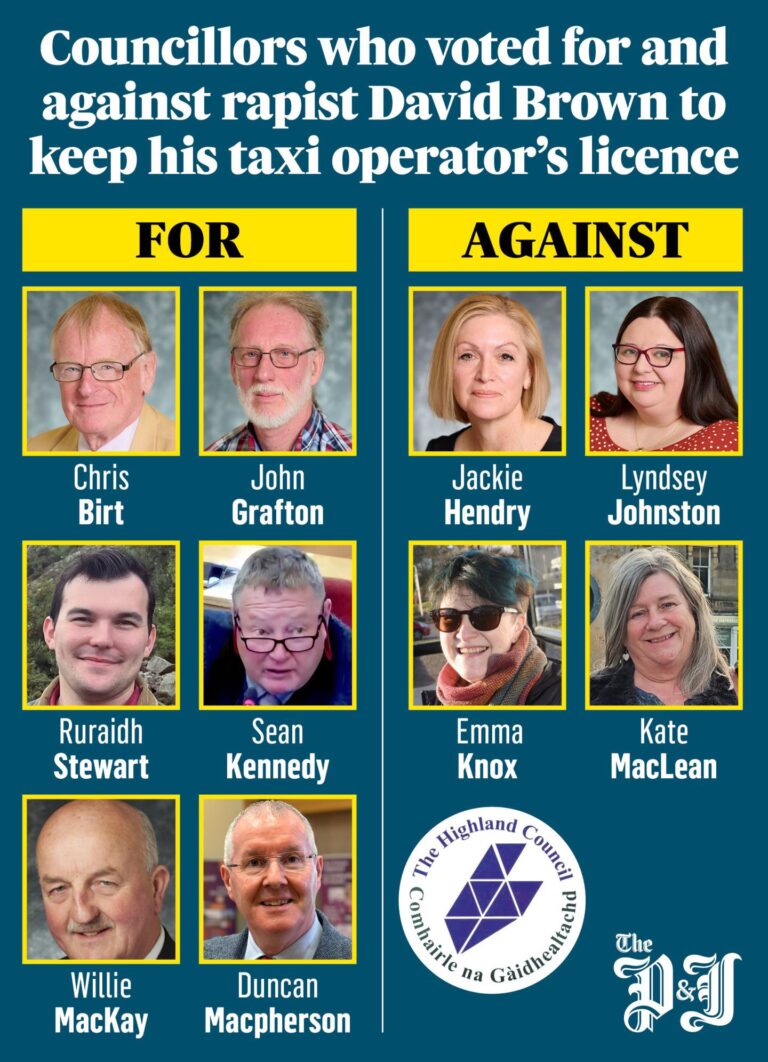
 Rebecca Buchan: Six men voted on a Highland Council taxi licence – none of them know what it’s like to fear the journey homehttps://www.pressandjournal.co.uk/fp/op ... i-licence/While those men were weighing up a licensing application, countless women reading about it were remembering every precaution they've ever taken in the back of a taxi.
Getting into the back of a taxi has never been as simple as opening the door.
Not for me, anyway, or I would argue, any other woman.
Before the car has even pulled away, I’ve usually shared my live location with someone.
I’ve checked the registration plate. I’ve made sure Uber’s safety features are switched on. Sometimes I’ve even pretended to be on the phone because a fake conversation somehow feels safer than silence.
I know I’m not alone.
Almost every woman I know has her own version of these rituals. They’re so ingrained we barely think about them anymore. We just do them.
Not because we’re paranoid, but because we’ve learned to.
Women spend enough of their lives being told to think about their own safety.
Don’t walk home alone. Text when you get in. Share your location. Trust your instincts. Check the registration. Sit behind the driver. Call someone if something doesn’t feel right.
We’re constantly reminded that keeping ourselves safe is, in part, our responsibility.
Which is why I couldn’t stop thinking about all of those little precautions as I read about Highland Council’s decision to allow a taxi operator’s licence to remain in the name of David Brown – the man jailed for raping a woman in his own taxi.
There are some news stories where the facts almost become secondary.
Not because they don’t matter. They do.
But what stays with you long after the headlines have faded isn’t the nuts and bolts; it’s the message.
When I read that six male councillors had voted to support the application, I couldn’t help but think about the difference between making a decision and living with its consequences.
Because while those men were weighing up a licensing application, countless women reading about it were remembering every precaution they’ve ever taken in the back of a taxi.
I’ve read the council’s explanation. Brown cannot drive a taxi, and his driver’s licence was suspended long before his conviction.
Those male councillors will never know how it feels to fear a journey homeThe operator’s licence is something different, and the decision is now being referred back to the full council for further consideration.
I understand all of that.
I also know Highland Council’s own licensing officers recommended the application be refused.
That tells me this wasn’t simply a black-and-white administrative exercise. There were people within the process who recognised that this decision carried a significance far beyond paperwork.
And that’s where I think the committee got it wrong.
For me, this was never really about the licence.
It was about the message.
As I looked at those sitting around the committee table, I couldn’t help thinking that many of the male councillors involved would never know what it feels like to take those precautions in the first place.
They’ll never scour an app to make sure every safety feature is switched or discreetly check the child lock isn’t on.
These are all things I have done, and almost every woman I know would say the same.
Perhaps those around the committee table saw a licensing matter.
Many women saw something entirely different.
They saw the name of a convicted rapist continuing to be associated, however indirectly, with a licensed taxi business.
Whether Brown ever sits behind the wheel again is almost beside the point.
Highland Council taxi licence saga highlights male privilegeFor women, the damage was done the moment his name remained attached to a licensed taxi business.
If the intention is that the business continues without him, then surely the obvious course would have been to create a clean break. Encourage his wife to apply for an operator’s licence in her own name and start afresh.
Remove any lingering association between the business and the man whose crimes shattered trust.
This isn’t about punishing family members for someone else’s crimes. Quite the opposite.
A licence in her own name would have sent a powerful message that the business was moving forward independently, with no remaining connection to the man whose actions destroyed public confidence.
Instead, the message became muddled.
For many women, a vote to retain the licence feels uncomfortably close to minimising the enormity of Brown’s crimes. That may not have been the councillors’ intention, but messaging isn’t about intention.
It’s about how decisions are received.
This isn’t about arguing over the finer points of licensing law.
It’s about recognising that there are some names which, because of the unimaginable harm attached to them, should no longer appear anywhere near a business that relies so heavily on public trust.
Every decision made by elected representatives sends a message.
Sometimes those messages reassure people. Sometimes they leave them wondering whether anyone in the room stopped to think about how the decision would feel to those expected to live with it.
For me, that’s the most disappointing part, not the legal arguments, not the technicalities, the missed opportunity.
An opportunity to send a clear, unequivocal message that when it comes to women’s safety: perception matters.
Women don’t need institutions to explain the difference between a driver’s licence and an operator’s licence.
We understand perfectly well.
What we want is to know that the people making these decisions understand us.
Rebecca Buchan is deputy head of news and sport for The Press and Journal and Evening Express.
 Login
Login Register
 FAQ
FAQ




](./images/smilies/eusa_wall.gif "Brick wall")


